




Inside the World Cup 2026: Sporting Event Accreditations
As the eyes of the world are turning to North and Central America for the 2026 World Cup, billions of fans are focusing entirely on the pitch. However, behind the scenes, an invisible engine of security, logistics, and identity management is running at full throttle. At the heart of this operational marvel is a small but critical piece of technology: the event accreditation badge.
For mega-events like the World Cup, an accreditation badge is far more than a simple souvenir or a basic pass. It is a highly sophisticated, secure document that controls access across dozens of venues, manages the movements of thousands of individuals, and ensures the absolute safety of athletes, dignitaries, media, and fans alike.
In this article, we take a deep dive into how world-class sports accreditations are processed, designed, printed, and deployed—and what it takes to make the event run smoothly on the ground.

1. The Journey to the Pitch: How Players and Staff Get Accredited
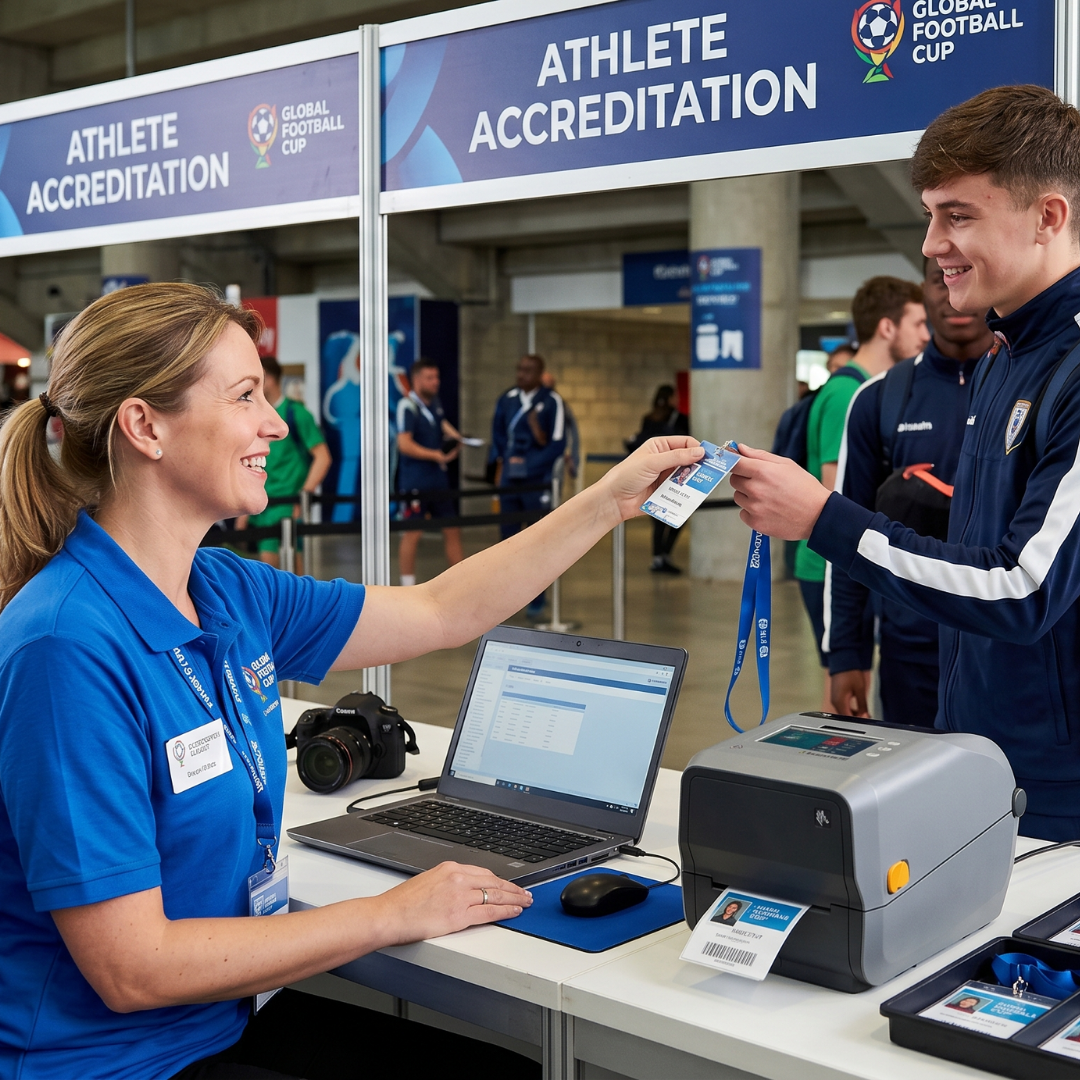
The accreditation process begins months before a ball is even kicked. It is a rigorous, multi-tiered journey designed to ensure that everyone entering restricted tournament zones is fully vetted.
- The Data Collection Phase: National football associations, media outlets, catering companies, security firms, and venue staff submit detailed personal information for their representatives through a secure, centralised event management portal.
- Background & Security Vetting: Once submitted, this data undergoes thorough background checks to comply with international and local law enforcement agencies. This step is non-negotiable for ensuring the safety of high-profile athletes and attendees.
- The Final Approval & Tokenisation: Once cleared, the individual is assigned a unique profile in the tournament database, which is mapped to a secure digital token. This token holds their exact access permissions, ready to be flashed onto a physical badge.
When players arrive at the tournament headquarters or their initial training camp, they are issued their physical badge using the data that is stored on the tournament database. From that moment on, it becomes their mandatory lifeline for moving between hotels, transport hubs, training facilities, and stadium zones.
2. Anatomy of a World-Class Badge: Design & Functionality
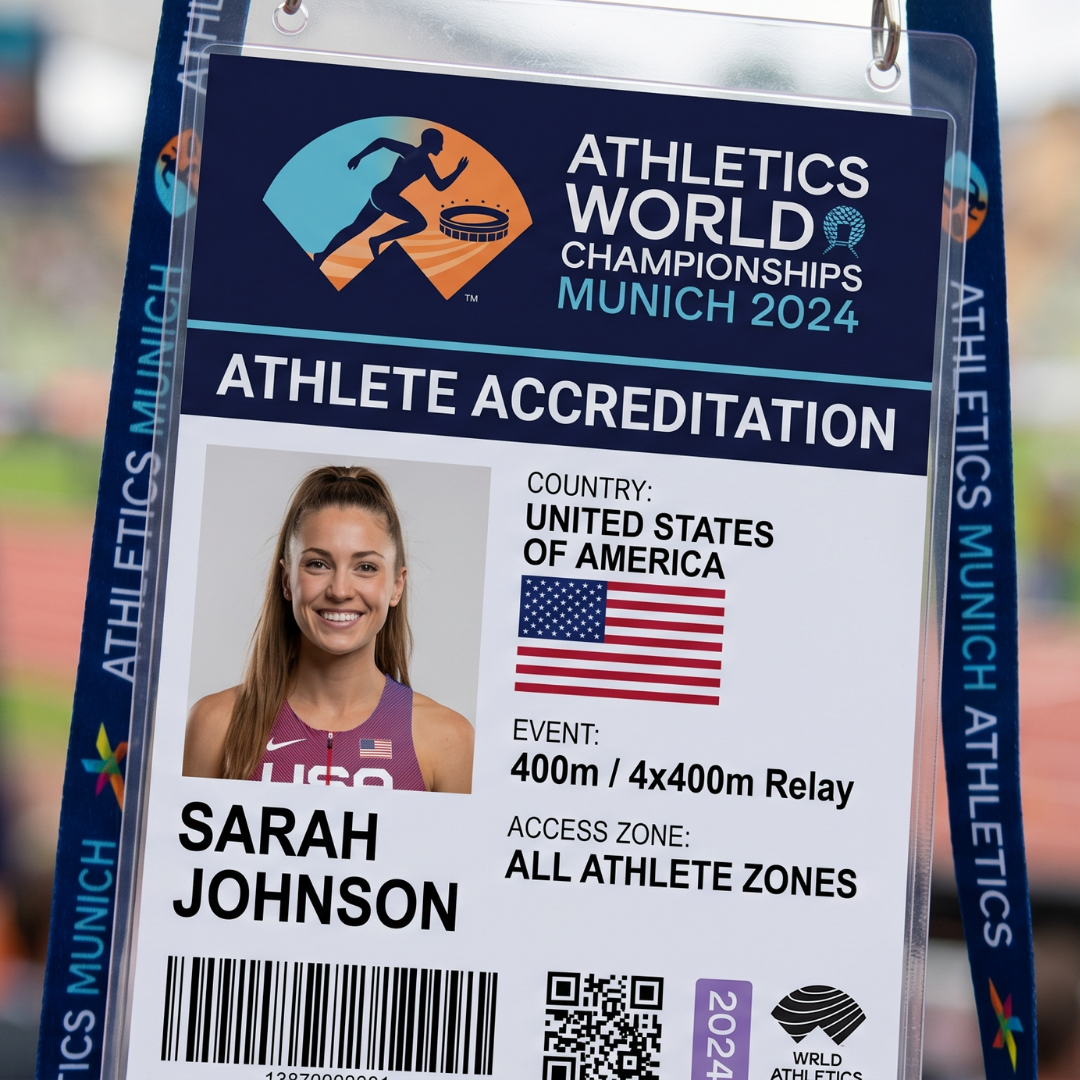
A World Cup-grade accreditation badge is a masterpiece of functional design. It balances high-visibility branding with complex, multi-layered security features.
- Visual Access Matrix: Turn to any major sporting event badge, and you will see a grid of bright colours, letters, and numbers. These zones instantly inform security personnel exactly where the wearer is allowed to go. For example, a badge might feature an 'F' for the field of play, an 'M' for media centres, a 'G' for general stadium zones, or a 'V' for VIP areas.
- Anti-Counterfeiting Measures: Modern tournament badges utilise advanced security features to combat counterfeiting. These include holographic overlays, micro-print text, and ultraviolet (UV) inks that are only visible under specific security lighting.
- RFID & NFC Integration: Crucially, elite badges embed RFID (Radio Frequency Identification) or NFC (Near Field Communication) chips. These allow contactless scanning at stadium perimeters, tracking foot traffic in real-time, instantly flagging revoked access, and preventing the use of cloned badges.

3. The Blueprint of Durability: Commonly Used Materials
Given that a tournament spans several weeks and therefore means that badges are exposed to intense wear, friction, and varied weather conditions across diverse climates, material choice is paramount.
- Heavy-Duty PVC/PET Composite: Traditional credit-card-style badges often utilize a robust composite blend of PVC and PET. This prevents snapping and cracking under stress while allowing high-definition graphic printing.
- Synthetic Polyethylene Paper (e.g., Teslin or Tyvek): For oversized event passes, tear-resistant synthetic papers are incredibly popular. They are completely waterproof, highly flexible, and virtually indestructible, making them perfect for outdoor field staff, security, and photographers who face the elements.
At Badge Wave we’re in the final stages of product development and sourcing for this material type. An added bonus is that they’re fully recyclable, unlike PVC & PET materials. - Self-Adhesive: A common, readily accessible and durable material used is self-adhesive plastics. These are chosen because like Synthetic Polyethylene Paper, they are harder to tear and therefore more durable for multi-day events. They are also largely resistant to liquid exposure, so the data and information on them remains visible for days on end.
4. On-Site Printing: Direct Thermal vs Inkjet?
While thousands of badges are pre-printed ahead of the tournament, sporting events require massive on-site printing operations to handle late squad replacements, lost badges, and unexpected VIP arrivals. Which technology wins the day on-site? At Badge Wave we can assist you with both.
- Direct Thermal Printing: Known for its ultra-fast speed and reliability. Because it requires no ink or toner ribbons, it eliminates the logistics of managing fragile consumables on-site. However, direct thermal is limited to monochrome (black) printing and can be sensitive to prolonged exposure to intense heat or direct sunlight. In hot climates like Central and North America, this could prove to be a problem.
- Inkjet: This technology provides full-colour, photo-quality output and exceptional crispness in print quality. It’s perfect for rendering player photographs in high security resolution. The downside is that it has a larger hardware footprint, requires continuous ink/ribbon supply, and is slightly slower per badge. We stock the highly reviewed Epson CW-C4000e.
The Winning Strategy: Elite sporting events typically employ a hybrid approach. The outer "shell" of the badge containing the tournament branding, holographic elements, and structural design is pre-printed in bulk off-site using heavy-duty offset or industrial inkjet machinery, like ours.
On-site at the venues, organisers can use high-speed, heavy-duty direct thermal printers to instantly apply the variable data—such as the player's name, real-time photo, barcode, and specific access quadrants—directly onto the pre-printed badge stock in seconds.
Partner with the Event Badge Experts
Whether you are organizing a regional tournament or gearing up for an international spectacle, executing a flawless, secure accreditation strategy requires the right infrastructure.
At Badge Wave, we specialise in supplying tournament and event organisers with everything needed to keep operations running smoothly. From robust, field-tested on-site badge printers (both the Zebra ZD621 and Epson CW-4000e) to fully customised, high-security badge stock and durable lanyards—we have you covered.
Don't leave your event's security and flow to chance. Contact our team today to secure your event's accreditation infrastructure and let us help you run a flawless sporting event.

- June 24, 2026

FAQS
Frequently Asked Questions
This will depend on what you want to print onto your badges on the day of your event. Our thermal tickets are designed to be printed on the Zebra range of printers, namely the ZD621 and GK420D. These printers will print your data and text in a single colour. Our Inkjet tickets are designed to be printed on the Epson C3500 and C4000 range of printers, which both allow for full-colour on the day printing.
Direct thermal technology uses a heat-sensitive coating to create clear, high-quality text or images from a single-colour printer, offering a simple and efficient printing solution without the need for ink or toner. Our Inkjet material is specially coated to allow a CMYK print process in full colour.
Typically, our on-site printers will accept any badge width up to a 4” wide. The most common size for an event badge is 4” x 12”, which folds to 4” x 6” double sided.
You can view our artwork requirements on the downloadable, editable templates on each product page.
Yes this is possible! We would just need a good understanding of your event, your branding guidelines, what is required to be printed on the badge and the logo(s) that you wish to feature. Email us at: BadgeWave@soabar.co.uk