




The Science of Capturing Live Event Data
For decades, the standard event badge served one main purpose- to allow security teams to see who was meant to be there and who wasn’t. It was a static piece of paper stuffed into a flimsy plastic wallet, offering zero utility to the organiser once the attendee walked through the front doors.
But the modern live event landscape operates on a completely different currency—data. In a business environment driven by digital attribution, stakeholders require tangible proof of return on investment. Exhibitors need to capture leads, session curators want accurate traffic metrics, and organisers demand clear behavioural data to guide the budget for next year's event. Turning a blind eye to physical attendee habits is no longer an option.
By transforming an event badge into a sophisticated data capture asset through the use of QR codes and RFID microchips, organisers are successfully building a bridge between physical presence and digital intelligence. At Badge Wave, we want to let you in on exactly how it works.
1. The Active Touchpoint: QR Code Ecosystems & Lead Retrieval
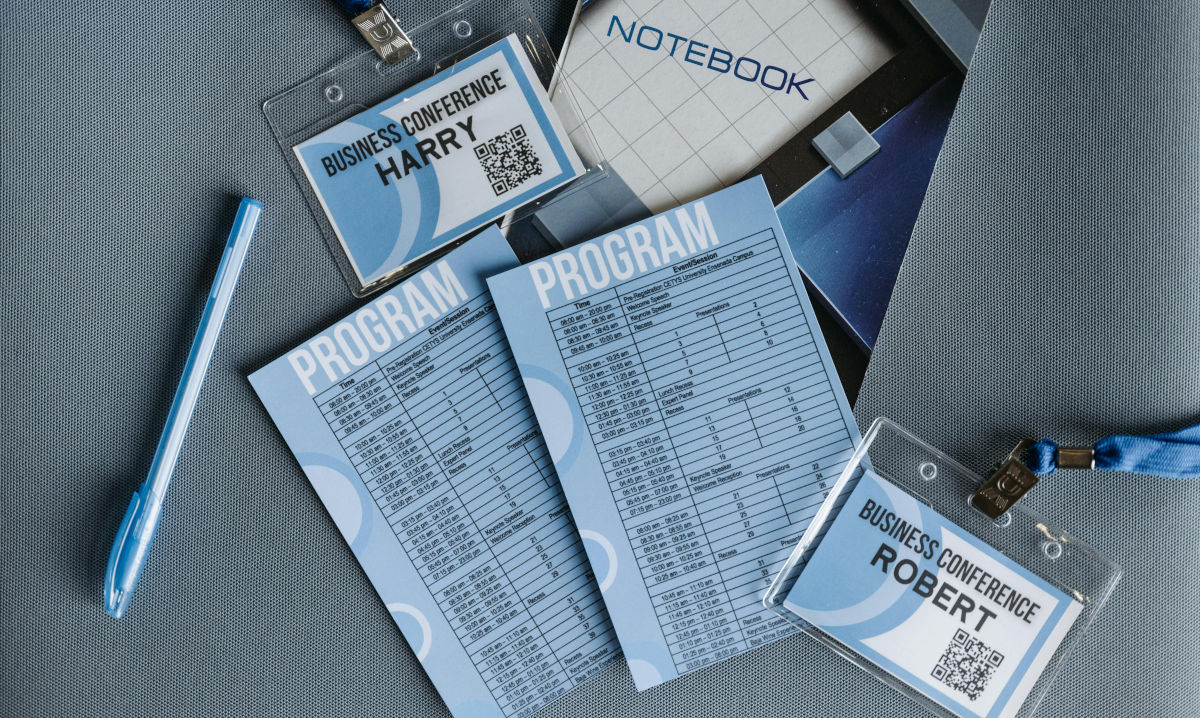
The most immediate, visible version of data collection occurs via the QR (Quick Response) code—printed directly onto the attendee's badge. This is a touchpoint that requires a conscious, intentional scan by either staff, an exhibitor, or the attendee themselves.
Where Does the Scan Link Up To?
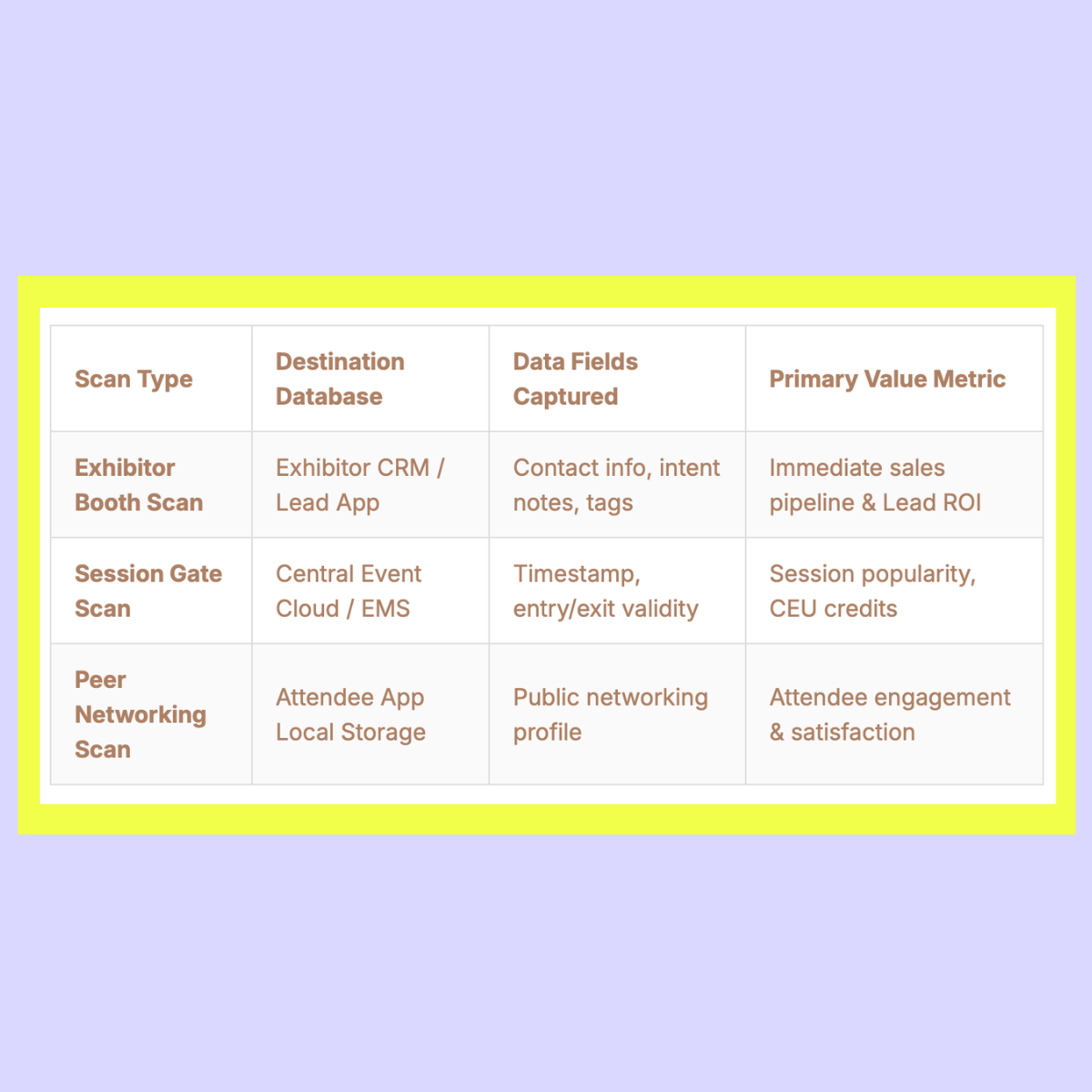
A common misconception is that a badge QR code simply contains raw text of the user's business card info. In a professional event tech ecosystem, the QR code contains a unique encrypted identifier. When scanned, this identifier pings an application programming interface (API) that instantly routes to specific locations depending on who is performing the scan:
- The Exhibitor's Lead Retrieval System: When a booth representative scans a badge using a dedicated lead retrieval app, the encrypted ID fetches authorised fields from the central event registration database. It securely populates the exhibitor’s local app with the attendee's name, job title, company, email, and purchasing authority. Crucially, it allows exhibitors to immediately attach custom qualification tags or follow-up notes while the conversation is still fresh.
- The Organiser’s Customer Relationship Management (CRM) Platform: When scanned at the entrance of a restricted session, workshop, or VIP lounge, the scan logs a timestamped event entry directly into platforms like Salesforce, HubSpot, or a dedicated Event Management System (EMS) such as Cvent or Zoho Backstage.
- The Attendee Mobile App (Peer-to-Peer): If another attendee scans the QR code using their event app, it acts as a digital handshake, instantly saving the profile to their personal networking directory without revealing private contact details like phone numbers until mutual consent is granted.
2. The Passive Tracker: RFID and Behavioural Intelligence
While QR codes require an active action, RFID (Radio Frequency Identification) chips operate completely behind the scenes. By embedding an ultra-thin, lightweight RFID inlay inside a standard paper or butterfly event badge, organizers unlock a stream of passive data tracking.
Unlike QR codes, attendees don’t need to stop to scan anything. As they walk through thresholds fitted with subtle RFID reader antennas, their presence is automatically and securely recorded.
Note on Privacy & Consent: Passive tracking must always comply with local regulations (such as GDPR or CCPA). Attendees should be informed during registration about what data is collected and given a seamless option to opt out, ensuring transparency from day one.
Mapping Attendee Habits to Improve Next Year's Event
- Dwell Time and Session "Stickiness"
Knowing that 500 people walked into a keynote room is helpful; knowing that 200 of them walked out exactly 15 minutes into the presentation is crucial knowledge. RFID records the exact duration an individual spends in a specific zone. If dwell times for a particular track are consistently low, you know to swap out the speaker, format, or topic for the next year.
- Foot Traffic Optimization & Spatial Design
RFID readers scattered across an exhibition floor generate real-time spatial heat maps. If data reveals that the back-left section of the hall received 70% less foot traffic than the right quadrant, you know the layout is flawed. For next year, you can re-engineer the floor plan—placing high-draw elements like the catering stations or main stages in the back to pull traffic naturally past quieter exhibitor booths.
- Predictive Monetisation and Tiered Pricing
With precise data proving which premium spaces or sponsorship zones received the highest dwell times, your sales team is armed with verified metrics to command higher sponsorship costs. You can mathematically prove to a brand why a premium booth space or lounge sponsorship is worth a 20% price increase next season.
The Ultimate Unified Tech Stack
The true magic happens when active QR data and passive RFID data merge. By combining the immediate, high-intent transactional data of a QR lead scan with the contextual, behavioural history of an RFID timeline, you create a comprehensive 360-degree attendee profile.
This combined data layer empowers marketing teams to send hyper-personalized post-event emails ("We noticed you spent over two hours in our AI workshops—here is an exclusive article..."), solidifying event return on investment and turning a simple physical gathering into an optimisation engine for years to come.
Key Takeaway for Planners:
Stop looking at badges as line-management expenses. Treat them as the vital sensors of your event’s data engine. Start small with integrated QR codes for lead capture, and graduate to passive RFID tracking when you are ready to completely revolutionise your event design and spatial monetisation.
Do you need smart, well-designed badges for your next event? Let us know what you’re looking for or use our knowledge and expertise to guide your choice of badge for your next exhibition. Badge Wave provides card and self-adhesive blank and full-colour pre-printed badges that allows for data capture and RFID habit tracking. Order from us today.

- May 28, 2026

FAQS
Frequently Asked Questions
This will depend on what you want to print onto your badges on the day of your event. Our thermal tickets are designed to be printed on the Zebra range of printers, namely the ZD621 and GK420D. These printers will print your data and text in a single colour. Our Inkjet tickets are designed to be printed on the Epson C3500 and C4000 range of printers, which both allow for full-colour on the day printing.
Direct thermal technology uses a heat-sensitive coating to create clear, high-quality text or images from a single-colour printer, offering a simple and efficient printing solution without the need for ink or toner. Our Inkjet material is specially coated to allow a CMYK print process in full colour.
Typically, our on-site printers will accept any badge width up to a 4” wide. The most common size for an event badge is 4” x 12”, which folds to 4” x 6” double sided.
You can view our artwork requirements on the downloadable, editable templates on each product page.
Yes this is possible! We would just need a good understanding of your event, your branding guidelines, what is required to be printed on the badge and the logo(s) that you wish to feature. Email us at: BadgeWave@soabar.co.uk